Writing3 min read
Writing case studies made easier
How Claude and I made a tool to interview me for my case study.
The problem
I was trying to write the case study for the product that I designed for almost three years. I knew it inside out, but my mind racing thinking of everything I did and staring at a blank document had me nowhere even after 2 days.
I mean, yeah, I did not do the due diligence to document regularly (I was well settled in that role) but no point of crying over spilt milk. All the decisions, all the moments were in my head, I just did not know how to start. Ask me in person and the stories come out. Give me a blank box and I go blank too.
So I asked Claude for an interviewer -
…like i know all the things, its just hard to look at a body of text, and its hard to recall. I want a tool where i can basically keep answering questions and i have text ready for the case study. But it needs to be smart it should be able to ask pointed questions about the project, like i am a senior designer, and if i reply then it should be able to give me a score on the answer.
I didn’t write a line of code (shocker). There’s no backend I run. It’s one private HTML page on claude.ai that saves answers to a small database claude.ai keeps for it. Claude Code reads that back into the case study.
I see one question and I answer the way I’d say it out loud (using Wispr Flow). It scores me out of ten on what a hiring manager reads for like specific details, evidence, my role, tradeoffs and outcomes. It also asks follow-up questions.
I also added something for when I’m feeling stuck that helps me find words and gives me smaller questions and sentences to finish. When I’m done with an answer, I can draft it, and it cleans it up, retains my language, cuts out my repetitive fluff, and writes the paragraph. Where I have not specified something it leaves a [?] instead of making things up.
Let me tell you, it totally works. The follow-ups pulled out things that I had forgotten about, for example when it asked me how I did the market research, I remembered that I used to order things on quick commerce platforms and talk to riders to get a peek into apps that they use (usually not available on public domains).
“None of that was in my draft.”
It wasn’t perfect. An answer sometimes got 2 out of 10 (even if I had given a thorough answer), and it asked me the same follow-up twice. So version two judges only what the question asks, and never repeats itself.
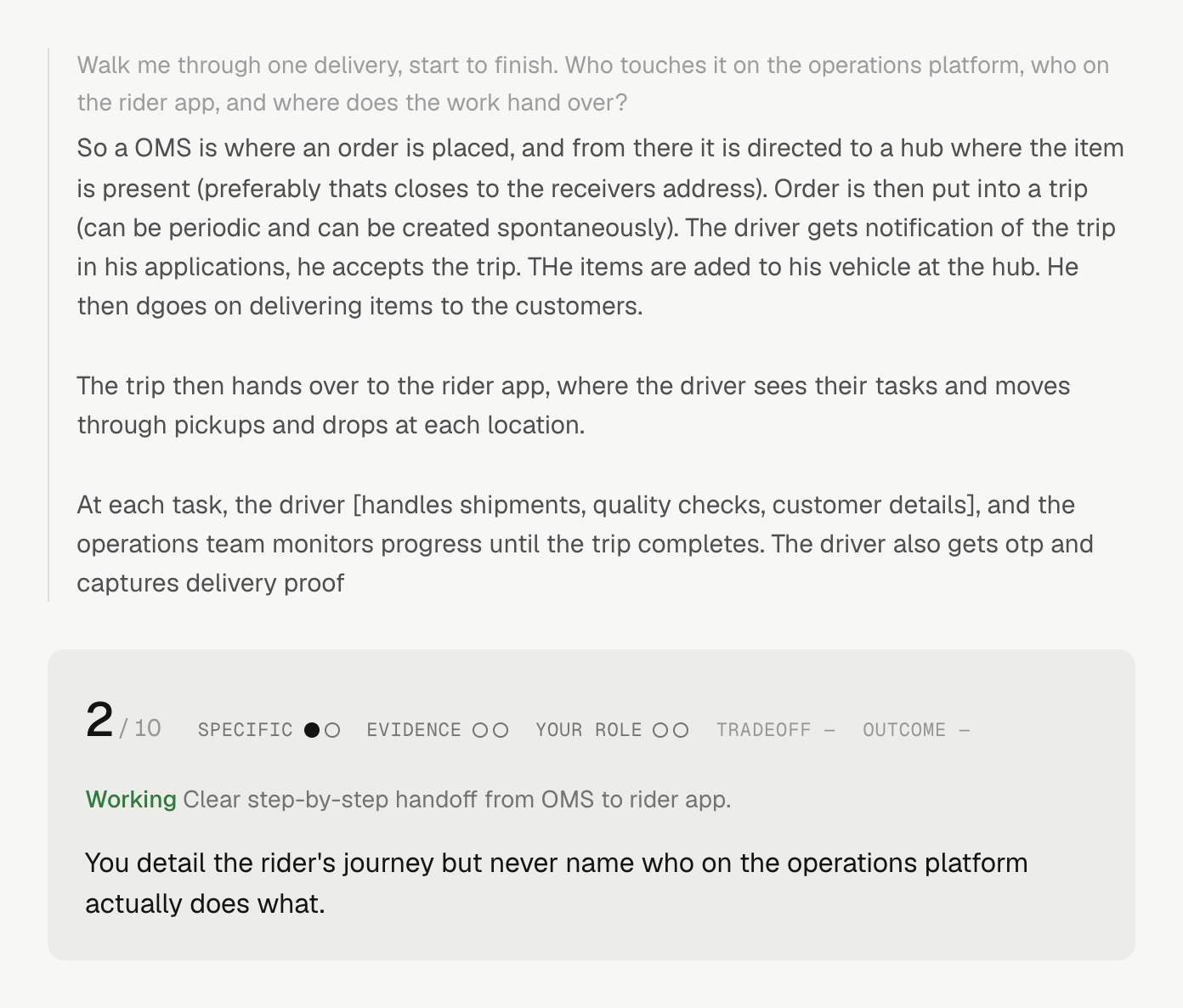
It also went through some changes, the original structure I had made was clearly too repetitive. I had to keep going over the same decisions. I realised that the structure can itself be a little different, a lot more focused. That was an intuition call, which is still needed.
The next version asked eight questions instead of twenty-five (with context of what I had already said), and had a Notes space for the things I wanted to add that did not fit into a question. I did all eight in about an hour.
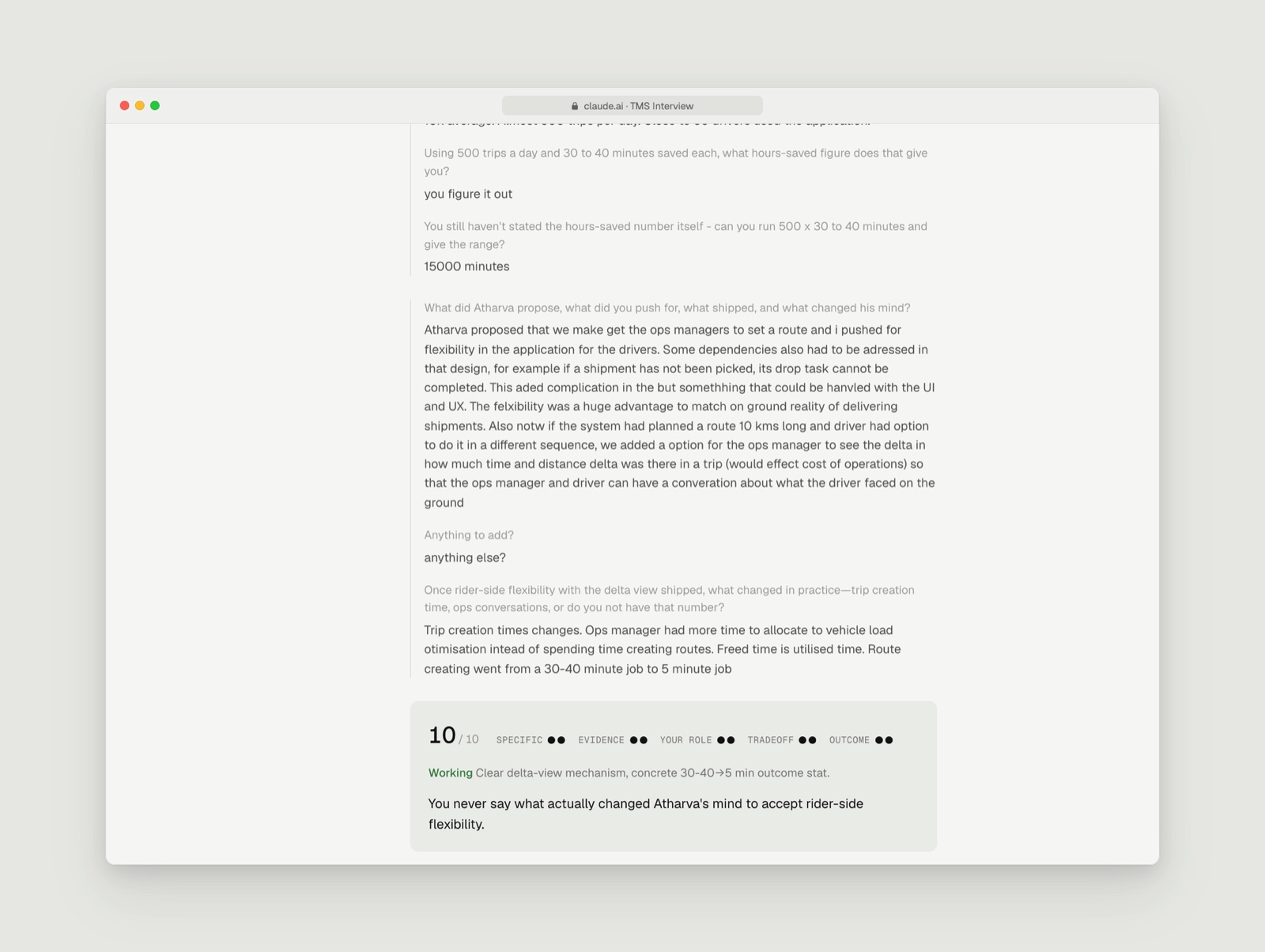
There is something so powerful about making tools for yourself that solve your problems. I think a big part of this was just to be able to identify the friction I was facing and thinking about how I can change this for myself.
Next steps - try and convert this into something a lot of people can use!